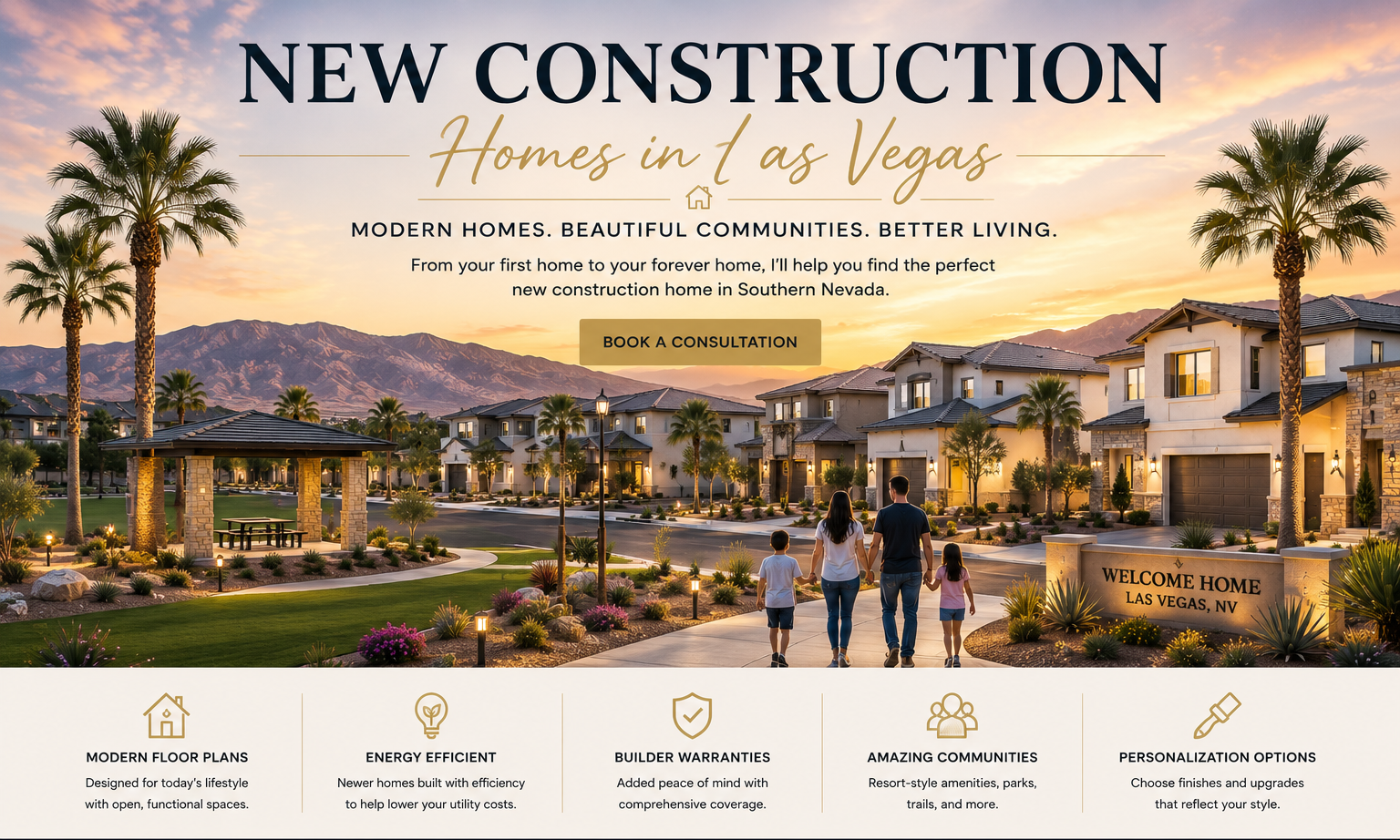
Ultimate Guide to Las Vegas New Construction Homes
Buying a brand-new home is exciting. Everything is fresh, modern, energy efficient, and designed for today's lifestyle. Whether you're relocating from California, moving across town, or purchasing your very first home, new construction offers opportunities that resale homes often can't.
At the same time, buying directly from a builder is very different from purchasing a resale home. Builder contracts, construction timelines, design center upgrades, lot premiums, warranties, inspections, and financing all work differently than many buyers expect.
As someone born and raised in Las Vegas, I've watched our valley grow from a handful of neighborhoods into one of the fastest-growing new home markets in the country. New communities continue to expand throughout Summerlin, Henderson, Southwest Las Vegas, and Northwest Las Vegas, giving buyers more choices than ever before.
Many of my California relocation clients are surprised by just how many brand-new communities are available here. Whether you're looking for your first home, a luxury property, a single-story floor plan, or a gated community with mountain views, there's likely a builder and neighborhood that fits your lifestyle.
This guide will walk you through everything you need to know about buying a new construction home in Las Vegas—from choosing the right builder and homesite to understanding builder incentives, warranties, inspections, and the homebuilding process. By the end, you'll have the knowledge to make confident decisions and avoid some of the most common mistakes buyers make.
Why Buy a New Construction Home?
New construction homes continue to grow in popularity because they combine modern design, improved energy efficiency, lower maintenance, and the opportunity to personalize your home before you move in.
Unlike many resale homes, new homes are built with today's lifestyles in mind. Open-concept living spaces, larger kitchens, flexible rooms for home offices, smart home technology, and energy-efficient features have become standard in many new communities throughout Las Vegas.
Many buyers also appreciate knowing they won't immediately have to replace an aging roof, HVAC system, water heater, or outdated appliances. Starting with everything brand new provides peace of mind and can reduce maintenance costs during the first several years of ownership.
Benefits of Buying a New Construction Home
- Brand-new home with modern finishes
- Energy-efficient construction and appliances
- Open floor plans designed for today's lifestyle
- Smart home technology
- Builder warranties
- Lower maintenance costs
- Opportunity to personalize finishes and upgrades
- Access to new community amenities
- Modern safety and building standards
- Better insulation and energy savings
For many buyers, these advantages outweigh purchasing an older resale home, especially if they plan to stay in the property for several years.
Is New Construction Right for You?
New construction isn't automatically the right choice for every buyer. The best decision depends on your timeline, budget, lifestyle, and long-term goals.
A new construction home may be a great fit if you:
- Prefer a move-in-ready home
- Want modern finishes and layouts
- Like open-concept living
- Plan to stay in the home for several years
- Want lower maintenance during the first few years
- Appreciate energy-efficient features
- Like the idea of personalizing certain design selections
- Want to live in a growing master-planned community
A resale home may be a better option if you:
- Need to move quickly
- Prefer mature landscaping and established neighborhoods
- Want a larger lot
- Need more flexibility in negotiations
- Are looking for a specific location where little new construction is available
Neither option is better for everyone. It's about finding the home that best fits your lifestyle and future plans.
New Construction vs. Resale Homes
One of the first questions buyers ask is whether they should buy a new construction home or a resale home.
The truth is that both have advantages, and understanding the differences can help you make the right decision.
Many buyers assume new construction always costs more, but that's not necessarily true. When you consider the potential cost of replacing older roofs, HVAC systems, flooring, kitchens, bathrooms, windows, or appliances in a resale home, a new home may provide better long-term value.
Why California Buyers Love Las Vegas New Construction
Many of my California relocation clients begin their home search by asking to tour new construction communities before looking at resale homes.
One of the biggest reasons is that many California buyers are coming from older homes that require regular maintenance and updates. Moving into a brand-new home where everything—from the roof to the appliances—is new can be a welcome change.
Another advantage is the opportunity to personalize your home. Depending on the stage of construction, buyers may be able to choose structural options, cabinetry, countertops, flooring, lighting, and other finishes that reflect their style.
California buyers also appreciate the thoughtfully planned communities throughout Las Vegas. Many neighborhoods include walking trails, parks, community pools, fitness centers, dog parks, playgrounds, shopping, dining, and community events that create a true neighborhood atmosphere.
Master-Planned Communities
One of the things that makes Las Vegas unique is the number of master-planned communities throughout the valley.
Instead of individual subdivisions scattered throughout the city, many new homes are part of larger communities that are carefully designed with parks, schools, shopping, recreation, and long-term growth in mind.
Many master-planned communities offer:
- Community parks
- Walking and biking trails
- Dog parks
- Splash pads
- Resort-style pools
- Fitness centers
- Sports courts
- Playgrounds
- Community events
- Shopping and restaurants
- Beautiful landscaping
- Open green spaces
Popular master-planned communities include Summerlin, Inspirada, Cadence, Skye Canyon, Valley Vista, and Southern Highlands. Each community offers a different lifestyle, price point, and selection of builders.
When choosing a new construction home, it's important to evaluate both the home itself and the community surrounding it. Two similar floor plans can provide very different living experiences depending on the neighborhood, amenities, and future development plans.
What Makes Las Vegas New Construction Different?
Las Vegas continues to be one of the country's most active new construction markets.
Unlike many parts of California where available land is limited, Southern Nevada continues to grow with new neighborhoods, schools, parks, shopping centers, and community amenities.
As someone born and raised in Las Vegas, I've watched entire sections of the valley transform over the years. Areas that were once open desert are now thriving communities with beautiful homes and excellent amenities.
This continued growth gives buyers more options than many other housing markets. Instead of choosing between only one or two builders, you'll often have several communities, multiple builders, and a variety of floor plans available within the same area.
That level of choice allows buyers to compare layouts, incentives, pricing, and communities to find the home that best fits their needs.
What You'll Learn in This Guide
Buying directly from a builder is very different from buying a resale home. Throughout this guide, you'll learn about:
- Dirt builds versus spec homes
- Quick move-in homes
- The new construction timeline
- Builder incentives
- Builder warranties
- Lot premiums
- Structural upgrades
- Design center upgrades
- Independent inspections
- Financing a new construction home
- Buying from California
- Touring model homes
- The best new construction communities in Las Vegas
- Common mistakes buyers should avoid
Whether you're buying your very first home or relocating from another state, understanding how the process works can help you make informed decisions and enjoy a smoother home-buying experience.
Dirt Build vs. Spec Home vs. Quick Move-In Home
One of the biggest misconceptions buyers have is thinking every new construction home is built the same way. In reality, builders typically offer three different options: dirt builds, spec homes, and quick move-in homes. Understanding the differences can help you choose the option that best fits your timeline, budget, and goals.
What Is a Dirt Build?
A dirt build means you're purchasing a home before construction has started or very early in the building process. In many cases, the lot is still just that—dirt.
This option gives buyers the greatest opportunity to personalize their home. Depending on the builder and construction stage, you may be able to select structural options, cabinetry, countertops, flooring, lighting, plumbing fixtures, and other finishes.
Advantages of a Dirt Build
- More opportunities to personalize the home
- Greater selection of floor plans
- Ability to choose your preferred homesite
- More control over design selections
- Everything is built specifically for you
Things to Consider
A dirt build also requires patience. Construction can take several months depending on the builder, labor availability, weather, permit timelines, and the complexity of the home.
If you're relocating from California or selling another home first, careful planning is important so your moving timeline aligns with your new home's completion date.
What Is a Spec Home?
A spec home, short for "speculative home," is a home the builder has already started before finding a buyer.
The builder selects many of the structural options and design finishes in advance, allowing the home to be completed much faster than a dirt build.
Depending on the stage of construction, buyers may still have limited opportunities to choose certain finishes, but most major decisions have already been made.
Advantages of a Spec Home
- Faster move-in timeline
- Less waiting
- Professionally selected finishes
- Often priced before completion
- Great option for buyers on a deadline
Many of my relocation clients choose spec homes because they offer a balance between buying new and moving sooner.
What Is a Quick Move-In Home?
A quick move-in home is either completed or nearly completed and ready for occupancy.
Everything has already been selected, including cabinets, flooring, countertops, paint colors, and upgrades.
If you need to move within 30 to 60 days, this may be your best option.
Advantages of Quick Move-In Homes
- Fast closing
- No construction delays
- You can see the finished home before purchasing
- Often eligible for builder incentives
- Great for buyers relocating on a schedule
The tradeoff is that personalization is very limited because the home has already been completed.
Understanding the New Construction Timeline
One of the most common questions I receive is, "How long does it take to build a new home?"
The answer depends on the builder, the size of the home, weather, labor availability, permit approvals, and where the home is in the construction process when you purchase it.
While every builder is different, here's what buyers can generally expect.
Phase 1: Purchase and Contract
After selecting your floor plan and homesite, you'll sign the builder's purchase agreement and submit your earnest money deposit.
During this stage, you'll also meet with the builder's lender if you're using their financing and begin the loan approval process.
Phase 2: Design Selections
If you're purchasing a dirt build early enough, you'll attend your design center appointment.
This is where you'll make many of the decisions that personalize your home.
Selections may include:
- Cabinets
- Countertops
- Flooring
- Backsplash
- Plumbing fixtures
- Interior paint
- Hardware
- Lighting
- Interior doors
- Stair railings
It's exciting, but it's also one of the easiest places to exceed your budget if you haven't planned ahead.
Phase 3: Construction Begins
Once permits are approved, construction begins.
Although every builder has its own schedule, you'll typically see the home progress through these major stages:
- Foundation
- Framing
- Roof installation
- Windows
- Plumbing and electrical rough-ins
- HVAC installation
- Insulation
- Drywall
- Interior finishes
- Cabinets and countertops
- Flooring
- Painting
- Exterior landscaping
- Final touch-ups
Watching your home come together is one of the most exciting parts of the process.
Phase 4: Final Walkthrough
Before closing, you'll complete a final walkthrough with the builder.
During this appointment, you'll learn about your home's systems, identify cosmetic items that need attention, and make sure everything is functioning properly.
Bring a notebook and don't be afraid to ask questions. This is your opportunity to understand how your new home operates.
Phase 5: Closing Day
Once your loan is finalized and the builder has received the certificate of occupancy, you'll sign your closing documents and receive the keys to your new home.
Congratulations—you're officially a homeowner!
Builder Incentives
One of the biggest advantages of buying new construction is the potential for builder incentives.
Builders frequently offer promotions designed to make purchasing a new home more attractive.
These incentives can change monthly and sometimes even weekly, depending on market conditions and inventory levels.
Common Builder Incentives
- Closing cost assistance
- Interest rate buy-downs
- Design center credits
- Appliance packages
- Window covering allowances
- Backyard landscaping credits
- HOA dues paid for a period of time
- Price reductions on select inventory homes
It's important to understand that incentives vary by builder, community, floor plan, and financing.
Some promotions are only available when buyers use the builder's preferred lender.
Don't Focus Only on the Incentive
While incentives are exciting, they shouldn't be the only factor when choosing a builder.
A builder offering $30,000 in incentives isn't automatically the better deal if another builder offers a better floor plan, a larger homesite, lower HOA fees, or a location that better fits your lifestyle.
I always encourage buyers to compare the complete picture rather than focusing on a single promotion.
Builder Warranties
Another major benefit of purchasing a new construction home is the builder warranty.
Although warranty coverage varies by builder, most offer protection for workmanship, systems, and structural components for specific periods of time.
Typical warranty coverage may include:
- Cosmetic workmanship
- Plumbing
- Electrical systems
- HVAC systems
- Structural components
Before closing, ask your builder to explain exactly what is covered, how warranty requests are submitted, and what maintenance responsibilities belong to the homeowner.
Understanding your warranty can save you time and frustration later.
Structural Upgrades vs. Design Center Upgrades
One of the biggest decisions buyers make during the building process is choosing upgrades.
Not all upgrades are created equal.
Understanding the difference between structural upgrades and design upgrades can help you spend your money wisely.
Structural Upgrades
Structural upgrades change the actual construction of your home.
Examples include:
- Extended patios
- Multi-slide glass doors
- Additional bedrooms
- Extra bathrooms
- Larger garages
- Fireplace additions
- Loft conversions
- Expanded kitchens
- Larger showers
- Additional windows
These upgrades generally cannot be added later without significant construction costs.
If you think you'll want one, it's usually better to include it during the initial build.
Design Center Upgrades
Design center upgrades focus on appearance rather than structure.
These often include:
- Cabinet styles
- Countertops
- Flooring
- Backsplash
- Light fixtures
- Plumbing fixtures
- Door hardware
- Interior paint colors
- Tile selections
Some design upgrades may cost less if completed after closing, while others are worth purchasing through the builder.
We'll compare those options together so you can decide where your money will have the biggest impact.
One of the most common mistakes buyers make is spending their entire upgrade budget on cosmetic finishes while overlooking structural options that can't easily be added later. A beautiful countertop can be replaced in the future, but expanding a garage or adding a multi-slide patio door after construction is far more complicated and expensive.
Choosing the Right Homesite
When buyers think about choosing a new construction home, they often focus on the floor plan and upgrades. While those are important, one decision you can't easily change after closing is the location of your homesite.
As someone born and raised in Las Vegas, one of the first things I look at isn't just the house—it's everything around it. What's behind the lot? Will there be future construction? How much afternoon sun will the backyard get? Is the home backing up to a busy street or a walking trail?
These are details that can affect both your enjoyment of the home and its future resale value.
Understanding Lot Premiums
Not every lot in a community is priced the same. Builders often charge a lot premium for homesites that offer a more desirable location or view.
A lot premium is an additional cost added to the base price of the home because of the location of the lot within the community.
Lots that may have a premium include:
- Cul-de-sac locations
- Corner lots
- Greenbelt lots
- Park-facing homes
- Mountain view lots
- Strip view lots
- Larger lots
- Lots with no rear neighbors
- Elevated lots
- Premium view lots
Lot premiums can range from a few thousand dollars to well over $100,000 depending on the community and location.
A higher lot premium doesn't automatically mean it's the best choice. The right homesite depends on your lifestyle, budget, and long-term plans.
West-Facing Backyards
This is something many buyers relocating from California don't think about until after they've moved in.
A west-facing backyard receives the strongest afternoon sun, especially during the summer months.
That doesn't mean it's a bad lot, but it's something to consider if you enjoy spending time outdoors or plan to add a pool, outdoor kitchen, or covered patio.
Depending on the home, a west-facing backyard may require additional shade structures or landscaping to create a more comfortable outdoor living space.
Corner Lots vs. Cul-de-Sac Lots
Buyers often ask which is better.
The answer depends on your priorities.
Corner Lots
Advantages
- Larger lot in many communities
- Only one direct neighbor
- More natural light
- Greater sense of openness
Things to Consider
- More sidewalk to maintain
- Additional street exposure
- Sometimes less backyard privacy
Cul-de-Sac Lots
Advantages
- Less through traffic
- Quieter streets
- Popular with many families
- Often larger pie-shaped backyards
Things to Consider
- May come with a higher lot premium
- Fewer homesites available
Neither option is automatically better. It's about choosing the location that best fits your lifestyle.
Look Beyond the Backyard Fence
One of the biggest mistakes buyers make is only looking at what exists today. I always encourage buyers to ask what is planned around the community.
Questions to consider include:
- Will another neighborhood be built behind the home?
- Is commercial development planned nearby?
- Will there eventually be schools?
- Is there future road expansion?
- Could a shopping center be built nearby?
- Will your mountain view still exist in five years?
A beautiful view today may look very different once surrounding land is developed. Views are not guaranteed. You will have to sign a disclosure stating that in advance.
Independent Home Inspections
One of the biggest myths about new construction is that you don't need a home inspection. I strongly disagree.
Even though the home is brand new, it's still built by people, and people can make mistakes.
An independent home inspection provides another layer of protection and may identify items that should be corrected before closing.
Common inspection items include:
- Roofing
- HVAC performance
- Plumbing
- Electrical systems
- Windows
- Doors
- Drainage
- Attic insulation
- Appliances
- Cosmetic issues
Some buyers also choose to schedule additional inspections during construction, depending on the builder and stage of the build.
A brand-new home doesn't mean a perfect home.
HOA Fees and Community Rules
Most new construction communities in Las Vegas are part of a homeowners association.
HOAs help maintain common areas and community amenities, but they also come with monthly fees and community rules.
Before purchasing, review:
- Monthly HOA dues
- Community amenities
- Parking restrictions
- Rental restrictions
- Exterior modification rules
- Landscaping requirements
- Pet policies
- Community maintenance responsibilities
Understanding these rules before closing helps avoid surprises after you move in.
What Are SID and LID Assessments?
Many buyers relocating from California have never heard the terms SID or LID.
These stand for Special Improvement District (SID) and Local Improvement District (LID).
These assessments help pay for public infrastructure that supports growing communities, such as roads, utilities, sidewalks, streetlights, and other improvements.
Not every community has SID or LID assessments, and the amount can vary.
Before purchasing, ask:
- Does this community have a SID or LID?
- If so, what is the remaining balance?
- How often is it paid?
- When will it be paid off?
- Can I pay it offer early?
Understanding these costs before purchasing helps you budget more accurately.
Financing a New Construction Home
Financing a new construction home is similar to financing a resale home, but there are a few important differences.
Many builders have preferred lenders who may offer incentives such as:
- Closing cost assistance
- Interest rate buy-downs
- Promotional financing
- Design center credits
- Reduced lender fees
While these incentives can be valuable, buyers should still compare financing options to determine what works best for their situation.
Your lender will help you understand:
- Down payment requirements
- Monthly payments
- Loan programs
- Interest rates
- Closing costs
- Cash needed at closing
Getting pre-approved before visiting model homes gives you a realistic budget and makes the buying process much smoother.
Buying a New Construction Home from California
Many of my clients purchase their Las Vegas home while still living in California.
Technology has made the process much easier than it was just a few years ago.
Remote buyers can often complete much of the transaction using:
- Virtual consultations
- Video home tours
- FaceTime walkthroughs
- Electronic signatures
- Online loan applications
- Digital document sharing
If you're unable to visit every stage of construction, I can provide video updates, photos, and walkthroughs so you can follow your home's progress from wherever you are.
Buying from another state doesn't have to be stressful when you have someone local keeping an eye on the process.
Summerlin New Construction
Summerlin continues to be one of the most sought-after master-planned communities in Las Vegas.
Buyers are drawn to its beautiful neighborhoods, mountain views, extensive trail system, shopping, dining, golf courses, and proximity to Red Rock Canyon.
New construction opportunities vary by village, with several builders offering luxury homes, townhomes, and single-family residences.
Browse all available new construction homes in Summerlin here. Summerlin New Construction
Henderson New Construction
Henderson offers a wide variety of new construction communities ranging from affordable townhomes to luxury custom homes.
Popular areas include Inspirada, Cadence, and several growing neighborhoods throughout West Henderson.
Many buyers appreciate Henderson's parks, walking trails, community events, and suburban feel.
Browse all available new construction homes in Henderson here. Henderson New Construction
Southwest Las Vegas New Construction
Southwest Las Vegas continues to experience tremendous growth. This area offers convenient access to shopping, restaurants, the airport, and the Las Vegas Strip while maintaining a more residential atmosphere.
Buyers can find a variety of floor plans, gated communities, and growing neighborhoods throughout Enterprise, Mountains Edge, and nearby communities.
Browse all available new construction homes in Southwest here.Southwest Las Vegas New Construction
Northwest Las Vegas New Construction
Northwest Las Vegas has become increasingly popular with buyers looking for mountain views, larger homesites, and outdoor recreation.
Communities such as Skye Canyon and nearby developments continue to attract buyers seeking newer homes with access to parks, trails, and expanding amenities.
Browse all available new construction homes in northwest here. Northwest Las Vegas New Construction
Top Builders in Las Vegas
Las Vegas is home to many respected national and regional builders, each offering different floor plans, price points, design styles, and communities.
Rather than asking which builder is "the best," I encourage buyers to ask which builder is the best fit for their lifestyle, budget, and priorities.
Some builders focus on first-time buyers, while others specialize in luxury homes, active adult communities, or semi-custom construction.
Choosing the right builder involves much more than comparing base prices. It's important to evaluate floor plans, included features, warranty coverage, upgrade costs, lot availability, community amenities, and overall value.
Tips for Touring Model Homes
Model homes are designed to inspire buyers, but they can also make it easy to lose sight of your budget.
Builders often showcase every available upgrade, and it's easy to assume everything you see is included in the base price.
As you tour model homes, ask questions such as:
- What features are included?
- Which upgrades cost extra?
- What options are structural?
- What can be added later?
- What is the current build timeline?
- Are there lot premiums?
- What incentives are available this month?
- Which appliances are included?
- Is landscaping included?
- What are the HOA fees?
Take photos, collect brochures, and compare communities before making a decision.
Most importantly, remember that the model home is designed to showcase possibilities. Your finished home may look different depending on the floor plan, elevation, and upgrades you choose.
With the right guidance, touring model homes can be one of the most enjoyable parts of buying a new construction home.
Common Mistakes Buyers Make When Purchasing a New Construction Home
Buying a brand-new home is exciting, but it's also very different from purchasing a resale home. Over the years, I've seen buyers make many of the same mistakes—most of which can be avoided with the right preparation and guidance.
Visiting a Builder Without Your Own Representation
One of the biggest misconceptions is that the builder's sales representative represents the buyer.
The builder's sales consultant works for the builder. Their job is to represent the builder's interests throughout the transaction.
Having your own REALTOR® means you have someone helping you compare builders, review contracts, explain incentives, evaluate communities, coordinate inspections, and advocate for your best interests from start to finish.
Falling in Love With the Model Home
Model homes are beautifully decorated to showcase every available upgrade. The furniture, lighting, wall treatments, landscaping, and premium finishes create an incredible first impression.
Before getting emotionally attached, ask what's included in the base price and what costs extra. Many of the features you see are optional upgrades.
Spending Too Much at the Design Center
Design appointments are exciting, but it's easy to exceed your budget.
Prioritize upgrades that are difficult or expensive to add after closing, such as structural changes, additional electrical outlets, larger showers, or expanded patios.
Cosmetic items like cabinet hardware, light fixtures, or paint colors are often easier to update later.
Choosing the Wrong Homesite
The floor plan isn't the only thing that matters.
Pay attention to future development, road noise, backyard orientation, nearby parks, power lines, and what may eventually be built around your home.
The homesite you choose today can have a significant impact on your enjoyment of the home and its future resale value.
Skipping the Home Inspection
Even brand-new homes should be professionally inspected.
Independent inspections can identify items that need correction before closing and provide additional peace of mind.
Focusing Only on Builder Incentives
Builder incentives can be valuable, but they shouldn't be the deciding factor.
Compare the overall value of the home, community, floor plan, included features, HOA fees, warranty, and location—not just the promotional offer.
Forgetting About Future Monthly Costs
Your mortgage payment is only part of the monthly cost of homeownership.
Be sure to budget for:
- HOA dues
- Property taxes
- Homeowners insurance
- Utilities
- Landscaping
- Pool maintenance, if applicable
- SID or LID assessments, if applicable
Planning ahead helps prevent surprises after you move in.
Rushing the Decision
Buying a home is one of the biggest financial decisions you'll make.
Take time to compare builders, communities, floor plans, and financing options before signing a contract. A little extra research today can save you time, money, and stress later.
Frequently Asked Questions
Do I need a REALTOR® when buying a new construction home?
Yes. The builder's sales consultant represents the builder, not the buyer. Having your own REALTOR® provides guidance throughout the process, helps you compare builders and communities, explains contracts and incentives, and represents your interests from contract to closing.
Is a home inspection necessary for a brand-new home?
Absolutely. Even new homes can have construction defects or items that need correction. An independent inspection provides an extra layer of protection before closing.
How long does it take to build a new construction home?
The timeline depends on the builder and the stage of construction. A dirt build may take several months, while a quick move-in home may be available within weeks.
What is the difference between a dirt build and a spec home?
A dirt build allows you to personalize many aspects of the home because construction has not yet started or is in the early stages. A spec home is already under construction, so most design selections have already been made.
Can I negotiate with a builder?
Builders don't always negotiate on the purchase price, but they may offer incentives such as closing cost assistance, interest rate buy-downs, or design center credits. Every builder and community is different.
Can I use my own lender?
In many cases, yes. However, some builder incentives are only available when using the builder's preferred lender. Compare all financing options before making your decision.
Are appliances included?
It depends on the builder and community. Some builders include kitchen appliances, while others offer them as upgrades. Always ask what's included in the base price.
Are landscaping and window coverings included?
This varies by builder. Some homes include front yard landscaping only, while others may offer backyard landscaping or window coverings as incentives or upgrades. Also with landscaping depending on the builder, you must have it completed within 6 months to a year. You must also get the plan approved by the HOA prior to doing the work.
What is a lot premium?
A lot premium is an additional cost for a homesite with a more desirable location, such as a cul-de-sac, mountain view, greenbelt, or larger lot.
Can I buy a new construction home while living in California?
Yes. Many buyers complete the entire process remotely using virtual tours, electronic signatures, video updates, and online communication with their real estate agent and lender.
Quick Answers About Las Vegas New Construction
Is buying a new construction home a good investment?
For many buyers, yes. New homes offer modern layouts, energy efficiency, builder warranties, and lower maintenance, making them an attractive long-term option.
Should I choose a dirt build or a quick move-in home?
Choose a dirt build if you want to personalize your home and have a flexible timeline. Choose a quick move-in home if you need to relocate sooner.
Do builders pay closing costs?
Sometimes. Many builders offer closing cost assistance, interest rate buy-downs, or other incentives, especially when buyers use the builder's preferred lender.
Which areas have the most new construction in Las Vegas?
Some of the most active new construction areas include Summerlin, Henderson, Southwest Las Vegas, and Northwest Las Vegas.
What is the first step to buying a new construction home?
The first step is getting pre-approved and meeting with a local real estate professional who can help you compare builders, communities, floor plans, and incentives before you visit model homes.
Born and raised in Las Vegas, I help buyers navigate the new construction process with local insight, builder knowledge, and guidance every step of the way. Whether you're relocating from California or already live in Southern Nevada, I'm here to help you compare communities, understand your options, and make confident decisions.
Buying a new construction home is about more than choosing a floor plan—it's about finding the right builder, the right community, and the right home for your lifestyle.
If you're thinking about buying a new construction home in Las Vegas, I'd love to help. Whether you have questions about builders, incentives, build timelines, or the best communities to fit your needs, feel free to reach out. I can also arrange in-person or virtual tours, so you can explore your options with confidence—whether you're here in Las Vegas or planning your move from another state.